Wanderlust

May 20, 2013

The cold is starting to enter the aging bones. Persistent winds of Antarctic origins drive the thermometer further and further towards that gruesome lower end. Layers of clothing grow onto the body until it feels like an onion with its layers exposed after having been sliced open on the cutting board. Something deep inside what many call the soul starts to shift, wiggle and stir. Memories of sweet tropical bliss bubble up between a shiver or two. Warm temperatures call; soothing water whispers. Cool coconut milk, colorful reefs, excellent fishing, and many of the other natural amenities of the lower latitudes dance before the gloomy eyes that have become partially glazed over by translucent cataracts of cooling contractions. The sun appears to have serious trouble climbing up into the heavens. It sleeps in for a good part of the morning and once it has begun its daily levitation it lazily hovers just barely above the hills on the other side of the bay even at noon. Its shine has lost a good bit of the characteristic bite it had only a month ago. It then sets prematurely and leaves many a task unfinished. Then bed covers and sweaters come out of moldy wrappings under the bunks and provide much needed insulation for the warm-blooded mammal we are. There’s a general slowdown happening all around us, and a shivering soul can barely make it through the daily thick and thin of life. Tucked in the miniscule fireworks of a synaptic interchange inside the prehistoric brain stem, tiny ferrite crystals activate. Their oscillation tunes to the magnetic field lines that penetrate all bodies on Earth and look for ways to counteract the temperature drop. They indicate North as the preferred route of escape. There are more obnoxious memory snippets now streaming through the river of time. They keep insisting again and again that life in the tropics under the palm trees, nicely shaded from the powerful sun and soothed in the cool trade wind breeze, is clearly much preferable to what the fast approaching winter is promising here in these latitudes. Their designation as sub-tropical becomes an outrageous misnomer for almost one whole half of every year.

opuafromokiato1

Miniscule Aluna in Opua’s town basin, viewed from across the Veronica Channel in the flowery hills of Okiato, New Zealand’s first (European) capital.

When it comes to choosing possible destinations for our travels a tendency seems to exist that always favors the new, the yet to be explored, the unknown. What has been visited and seen has lost attraction and charm. Five nations surround New Zealand like the fingers of a hand outstretched across the vast waters of the South Western Pacific. Each offers a peculiar set of attractions worthwhile to be visited and a specific cultural mélange to be studied. All of them are close enough to make a return trip down South possible once the seasons again have changed for the better. Over to the West behind the setting sun the continent-sized landmass of Australia promises a complicated bureaucracy with endless and costly paperwork, and mining really isn’t my favorite pastime. I’d love to have a chat with a real kangaroo or go swim with a croc, but there’s definitely not enough charm over there to pull me in. To the Northeast, where you can imagine the pinky and ring fingers of our invented hand dive into the sea just beyond the tropic of Capricorn, lay two island nations we have already visited, the subdued kingdom of Tonga on our way down from our brush with the southern end of the doldrums and tortured Fiji during my jaunt as a temporary bachelor last year. That only leaves the middle and index fingers for this year’s austral winter exploration. For a moment it looked like we might get to see both!

Some time back we had let the dice fall to the middle finger, which runs up the seismic island chain of Vanuatu towards the wild Solomons and even wilder Papua New Guinea. A coin toss is as good as anything substantiated by reason when it comes to making these kinds of decisions. I have long ago learned that there are no good and bad places on planet Earth if one is on a path of learning, and preferring the good over the bad has proven to lead to serious limitations in one’s own personal world views. But once a choice is made there’s a lingering radiation of highly charged flirtations with reconsideration, imagining plenty of things we will miss out because we chose one over the other. Those will eventually ebb out and lose their punch once actual travel has started and the adventure is on, and cause no further disruption. But before they do so, life happens in a limbo of alternate possibilities.

All the merrier we were then when out of the blue the offer of a crew position came flying our way through the miracle messenger service of electronic mail. French friends down in Auckland were preparing their 26 meter super yacht for a quick stint to New Caledonia and saw themselves short of crew for the stringent demands of their ever-diligent insurance agents, who require a minimum number of souls aboard during passages. They kindly thought of the two of us to fill in their missing numbers and were offering return airfare to Auckland and all other expenses paid in exchange of our humble presence on their board. This temporary change from the Spartan living aboard Aluna to the opulently luxurious living on a super yacht with the immediate wasteful use of resources implied was most certainly going to fan the flames of friendly fire.

Alas, things hardly ever turn out as planned on this side of life and before the excitement had a chance to die down, other news came in communicating that due to unfortunate circumstances the departure of the mighty vessel of our friends had been delayed, which could only mean that we would have to return and leave New Zealand aboard Aluna literally at the doorstep of the austral winter. This does not seem like the wise choice a careful mariner would make. It therefore happened that this little superficial dreams puffed like the soap bubble of a youngster who blows through his teethed plastic loop with way too much exertion from his lungs and the wiggling contraption bursts before his eyes and destroys the possibility of sealing off its perfect interior shape from the destructive influence of entropy. Deeper communal dreams have usually a much sturdier consistency in man and remain vigilant in their vibrant struggle towards reality. They are living beings ready to take flight with a need to breath air, to move around in space and express themselves towards their peers. Hopefully Vanuatu will turn out to be one of those!


Plugging Away

May 12, 2013

Bamboo continues to be the hinge of Aluna’s propulsion system. It stretches the sailcloth out into the wind and is supposed to hold them there in a certain shape. This implies quite a bit of strength and stiffness, which bamboo is exceptionally good at. It is so stiff for its weight and diameter that only the most modern synthetic materials can come close to matching its properties. You might remember that this summers fierce Southeasterlies managed to bring those properties to its knees and break my mainsail spar not only once but twice. This meant that Aluna was deprived of her fair weather sail and had me looking for a replacement spar.

As happens so often here in well-mannered Northland friends come to your aid from all directions at once. Even before heading down to Auckland almost two months ago Peter donated two of his marvelously straight bamboo culms, which were cut green and have since then been drying slowly over at his magic little kingdom across the river. It will take a total of at least six months of pampering to get them to the point where they will have dried slow enough to avoid any splitting. In order for them to be encapsulated in epoxy, reinforced with fiberglass and painted to protect them from the sun they need to be thoroughly dry. And this will definitely not happen before we have to head out into the big blue again to escape the fast approaching winter. For our upcoming trip to Vanuatu by the end of this month we need a quicker solution!

Enters Ted, who caters to most any need a cruiser can have with his ingenious engineering genius here in Opua, coming up with solutions where others stand for hour scratching their heads and wiggling their toes. Those solutions go from the outrageously brilliant to the simply unusual and end up most always being very straightforward and practical. My usual reaction to his suggestions is a perplex ‘why haven’t I thought of that!’, so when he suggested using aluminum tubing for a quick replacement spar the little ethnic pride that was given to me at birth cringed and squeaked violently, but I had to listen. Instant engineering computations in his amazing brain had come to the conclusion that the resulting spar, made up of two 5 meter sections joined by a sleeve of a slightly larger tube would come out to be lighter by a couple kilos than my bamboo spar. It would be dead easy to assemble. Everything could be done most probably in a single day. But it came at a cost. For most people three to four hundred dollars is a miniscule amount of money, which can be spent without any second thoughts. It is amazing how cheap aluminum has become. But in our limited cruising economy it would rip a good chunk of the little fat our cruising kitty has been able to accumulate over the last year and a half out of existence and leave a gashing hole in our financial portfolio. So it all ended up where many a brilliant idea expires: in the dungeon of economic unfeasibility.

The spar had broken neatly at the point where the halyard attaches it to the tip of the main mast. When bamboo breaks it does not shatter like wood. Its resilient longitudinal fibers remain intact but separate from each other at the moment of failure. That separation typically ends at the nodes to either side of the break. This meant that the pieces of bamboo left over from the accident were more or less intact and if I could device a way to join them back together I might end up with a spar that could be stronger than the original, just like a bone that has fractured and the body repairs it with extra tissue around the breakage point.

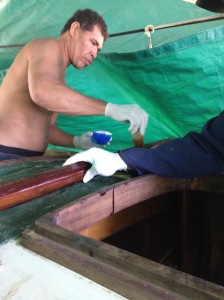
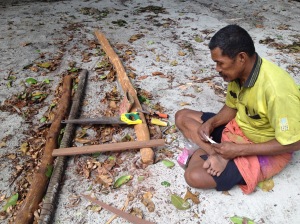
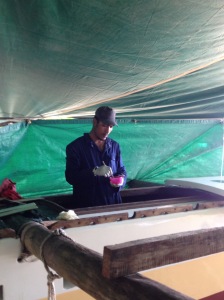
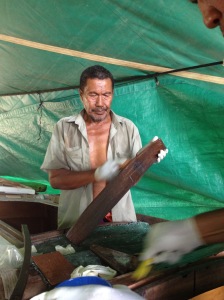
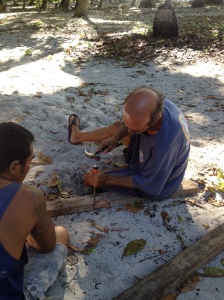
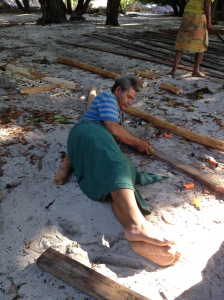
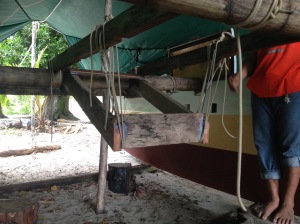
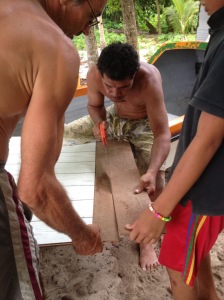
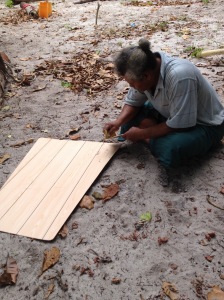
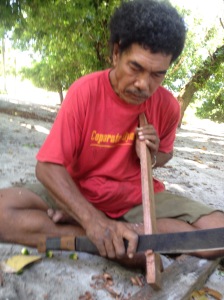
Whenever the slowly degrading weather allows for it that’s descending heavily down on us on our slippery slide towards the austral winter, you can find me at Ted’s shop tucked into the hillside behind Ashby’s Boat Yard, which has recently been incorporated into Northland Holdings, the secretive but opulent state owned entity that is managing and diligently milking the lucrative Opua Marina. Engulfed in a cloud of fine sawdust I’m fabricating wooden plugs that will slide into the bamboo culms for the entire length of the internodes adjacent to the ones that broke. It’s a tricky process. The bamboo has been brought forth by Mother Nature’s creative evolutionary magic, which means there are no perfect circles and no straight lines. Touch, feel and go it is then, shaving off the wooden material little by little until there is just enough left of it for the plugs to easily slide into the openings, without them wiggling around in there too much. Epoxy filled with glue mix will take up any empty space and make for a perfect bond between the two different plant materials. And of course on the outside a couple layers of reinforcing fiberglass will provide for the ultimate strength of this makeshift repair. A bridle will further help to distribute the considerable load and bending moment that acts on the halyard attachment when the wind increases and generates more and more pressure on the sail.

It will be as always with man’s technical things. A good leap of faith is needed to venture with these marginally constructed machines out into the chaotic world of the wavy oceans, which can brutally tear to shreds any and all human inventions if it happens to find it pleasing to do so. At the very least we will not only have saved our cruising kitty from prematurely collapsing into a very private but intimate replay of the Great Depression, but also be able to sweetly sleep with the clean conscious of having complied with the ecological mandate of reusing elements and resources whenever and as much as possible, instead of contributing to the menacing existence of an aluminum smelter maybe somewhere on the black back of Iceland and become part of a collective responsibility for the accelerated melting of three glaciers under the bright orange midnight sun in the elevated latitudes of the North Atlantic.

Back In The Bay Of Many Islands

May 5, 2013

It must have something to do with my growing up in the verdant countryside of Switzerland. Big cities always give me the creeps. Their artificial and impulsive energy seems at odds with all other living things wide and far. The concrete plastered earth is unable to breath. The animal world has been all but extinguished and the soothing greens of the forest replaced with blaring neon colors advertising fictitious comforts. Man becomes lost in his own mind, neurotic and competitive, making arrogant assumptions and very few openhearted people remain amongst a mass of self-centered maniacs.

It’s good to once again be able to walk for barely five minutes and be away from it all for a good and soothing while. I’m stepping over a dark-green colored rock that’s covered with colonies of cream-hued, sharp-edged oyster shells. It’s ready to be submerged again and again in the salty solution of the intertidal flood plains twice for every full rotation of the sun around the earth. Then I continue walking along a earthen yellow colored sand beach where millions of little remnants of abandoned molluscan and crustacean real estate is fast disintegrating into finer and finer fragments until they become the proverbial grains of sand that pass through the tiny orifice of the hourglass and create the sequence of time. Even finer ground material builds mudflats where cockles, crabs and mud worms feast on decomposing sludge before being feasted upon themselves by stealthy feathered descendents of the dinosaurs wading gingerly on slender stilts. Once out and about I have time to go through things with just myself, face to my own face so to speak, man to man, with an open ear, eager eyes and without any foreboding and premeditated arguments. There is not even the slightest amount of greed left in my veins now and I can observe and breathe without having to have a pretext for doing such and outrageous thing.

Not that this place up here in New Zealand’s Northland is without its share of problems. Wherever there are human beings there seem to be plenty of those around! Even in relatively minute numbers modern man’s impact on the land is nothing short of disastrous. But the degree of madness is greatly tempered by soothing Mother Nature, who looks diligently and tirelessly after all her flock day in and day out, making sure that nobody leaves the table hungry or in fact needy of anything essential for their survival.

The pace of things is important. It defines the rhythm of your daily life. It regulates the delicate balance of energy and matter needed for our every motion and commotion. Artificial acceleration of that pace therefore makes for a stressful rap that’s upbeat only in the beginning. It then quickly degenerates into a tasteless routine that goes on for much too long, held up only by the constant injection of artificial sweeteners into our bloodstream, an aggressive advertising assault on our six or seven senses and the constant bowing of our heads before the mandates of materialistic mass hysteria.

I cannot help but think about those things, bounce them around in my head while I wander around marveling at the undulating landscapes. These issues and their haunting screams for urgency and resolution bug me all the time, obnoxiously and exactly like the sand flies that come punching your skin here with an outrageous frequency after the heavy rains. Common sense dictates that you’re not supposed to scratch the miniature puncture wounds they leave behind on your legs and arms. But you catch yourself again and again scratching them anyway, risking ugly sores of infestation that drill their itch into your consciousness against your most mighty will and reason. Just like those little red dots that innocently decorate your dermis after the insects’ onslaught, the festering wounds of civilization itch and pinch my mental motions without mercy. Like a cosmic background radiation they resonate through every inch of happiness, every gram of joy and every strand of delight, as wholesome and filling as those may be. They are the dark matter of my daily universe, the elephant in the room that shelters me, the calm before the devastating storm of my awakening, and the constantly loving and nurturing mother of my despair.

Auckland Vignettes

April 29, 2013

The best and quite possibly the only way to stop all that persistent whining about life is to look at it. It breathes, after all, all around us at any moment of the day, and self-absorption is its mortal enemy number one. Here’s a series of snippets from the peculiar denizens we had the succulent pleasure of observing along the crowded avenues and hidden alleys of this snobby city.

One

On our way back from the closest bus stop to our floating home on loan at Westhaven Marina we are strolling along the narrow sidewalk along the South end of little St. Mary’s Bay towards the end of one afternoon just like any other. The sun hints at its intentions to set and call it a day from behind a veil of grey colored clouds to the West behind the silhouette of the ever-roaring Auckland Harbor Bridge. Two slender dragon boats plow the bay. In it a dozen or so paddlers bow under the growling shouts of the helmsman behind their backs and fiercely dig their blades into the water in a frenetic rhythm that cries wolf to the tune of quasi-military discipline and burning desires to atone flaccid muscles under crushing peer pressure towards imaginary fashion model lines. Pulsating wafts of a pungent olfactory clash between high-cholesterol sweat and designer deodorants stream by our cheeks, which are caressed and cooled by a stingy evening breeze, as lonesome joggers with faces suffering visibly from self-inflicted ambition hop by huffing and puffing. More comfort-centered humanoids dash by to our left inside their four wheeled metal cages, two lanes right beside us bringing them to and from the marina and yacht club buildings, then behind a glass topped concrete wall a whopping ten lanes of motorway streaming interminable hordes of daily commuters out of the city towards their spread out homes beyond the bridge and into it attracted by the many glittering and neon-lit nightlife opportunities in the Central Business District. Along the northern end of the bay where the reclaimed land of the marina rests behind dark brown and olive green rock walls a flock of little white triangles reveals itself slowly as a group of model sail boats, each sporting an impeccable Marconi rig, bobbing nervously towards little orange markers that draw a rhomboid shaped race course onto the far end of the water. The toy boats clearly move under remote control and must obey orders from their masters somewhere close by. A group of jean and t-shirt clad boys stand under the rows of Pohutukawa trees that frame the parking lot behind the rock wall without their crimson Christmas glory at this time of the year. The distance across the water is too great to see any great detail, but their movements are clearly linked to the fleet of triangle toys on the murky bay.

The mystery of who are the masters of the slaves solved no further attention is due to the phenomenon until we have rounded the bay and find ourselves at the side from where that little spectacle is controlled, although the uniformity of the tiny vessels had struck a sour note in my desperately creative brain that longs for and treasures variety as one of the many delicious spices of life. On the little wharf where normally dinghies from the yacht clubs are launched a flurry of little stands sit, arranged not too orderly, but once again astonishingly uniform in their appearance. They’re all made of two vertical slats of plywood with U-shaped padded openings on top and connected with four longitudinal struts. All are painted in a uniform brown and the color of the padding is uniformly white. So much order has my suspicion tickled with intrigued excitement. This does not look to me like the work of a rowdy gang of adolescents as would be fitting for the nature of these toys. By now the gaily bobbing toy boats are on their final stretch and plow their way towards the home base. Their masters reveal themselves to be a veritable grey-haired boys club, none of them much younger then half a century worth of Lents. The first group of four comes marching towards us, each with their joystick sporting radios strapped up front and I must say, I’m utterly surprised how serious a business theirs must be. The four wrinkled faces are ashen colored and supremely tense. It does not seem to be so much the difficulty of controlling the remote miniature vessels that causes them so much stress, but a dead serious conversation that appears to be evolving between them, the gravity of which must be outrageously burdensome to their very souls. We respectfully stand to one side of the path and let the somber procession pass. The next more loosely bunched group approaches and they must be the younger guard of this quite obviously very exclusive club. They also do not seem to bother about returning any kind of greeting to us regular mortals except for one. He has been left walking just a little bit behind his pals. For a short moment he is released from the grip of codified behavior needed to keep his membership dues up to date and he looks me straight in the eye. In a flash of absurd and highly embarrassing self-awareness his lips encased between a pair of impeccably shaved cheeks distorts to a sly smile that vanishes before it has the slightest chance to even think of blossoming. Condensed in that splinter of non-verbal communication rests a brazen shout of one clear and committed confession: I know! I know that you know, and we all know it too. It is after all a game we’re playing; I cannot help but admit to it. But don’t you dare tell it to the others!

Two

The western end of Auckland’s bustling waterfront along the Waitemata Harbor seems to be undergoing a rustling rant of redevelopment. Leaving behind the bustling transportation hub at the lower end of Queen’s Street you walk past the doors to the honorable Maritime Museum and under an America’s Cup winning sailboat perched gleaming white atop jet-black steel cradles. Those sport engraved plaques explaining the highlights of Kiwi maritime engineering to the hordes of camera-wielding Chinese tourists that stream like genetically altered ants out of busses with blackened windows and towering cruise ships with microscopic port lights. But they hardly drag their well-groomed bodies past the Viaduct Harbor Bridge, which opens and closes like a medieval draw bridge to the sound of a muffled siren every time a fancy yacht wants to enter or leave this high-priced little harbor smack in the middle of town. Then you continue your stroll along a row of expensive looking restaurants, the Auckland Fish Market, a shallow fountain covered with a postmodern-looking stainless steel pergola and finally end up amongst neatly manicured landscaping framed by old storage tanks before coming to a dead end at the aptly named Silo Marina, where super yachts moor with thick black lines and sing their songs of singular greed, proudly wrapped in shining stainless steel and soaked in expensively oiled teak.

But let’s turn around and return to the drawbridge. You might have noticed on the way over a yellow-hulled sailboat just to the South of it, tied up facing and parallel to a row of steps leading down to the water. A red flag fluttered happily in the wind up in the rigging and had you paid attention you would have noticed a sign strung to the boom promising a circus performance at 3:00pm and at 5:00pm. That row of steps has now become the audience part of an outdoor theater. A small crowd is sitting down there chatting away and kids run up and down, some with dark-rimmed glasses, others with cones of dripping ice cream. More families, couples and lonesome wanderers are arriving still and soon settle down. The show must be about to begin!

circus1 circus2 circus3

The jittery notes of a silent movie era piano hammering away to jumpy ragtime rhythms lures us into a story of a very eager but clumsy couple trying to get their sailboat in shipshape. To the great amusement of the audience they live between almost falling overboard, getting snared in the many lines on deck, hitting their heads on poles, booms and the many other implements needed on a sailing vessel, closing the hatches on each other’s feet and generally blaming the other for their own endless and rather ruthless line of shortcomings. After their initial skirmishes fore, aft and athwart ship on deck they soon find themselves aloft moving about the wires of their sailboat’s rigging with the same ease as we normal mortals do on firm and steady ground. Dressed in egg yolk yellow jumpers and white baggy pants the acrobatic couple continue their hapless chores with the classic dilemma of clowns, who never seem to reach the illusive goal of completing the practical tasks before them, harvesting reams of empathy with their cadence of misfortunes from an audience torn between pity and roaring laughter. Midair pirouettes suspended by two strips of white fabric whirling in the breeze, gliding abseil maneuvers of tranquil elegance, ascending the shrouds like monkeys, grasping them with bare toes and hand over hand, trapeze-like swinging around the main mast, and again and again the guaranteed attention grabber of almost falls here and there are all part of a rustic but definitely delightful bag of circus tricks.

circus5 circus4 circus7

While not exactly revolutionizing the stubborn stereotypes of the sexes the story treads lightly and good-humored. It meanders from the standard but always a bit sluggish male prowess that desperately needs to take charge in spite of latent technical insecurities across the gaping gender divide to the gentle but witty female physical intelligence, which in spite of doing the wrong things pushes the project at hand in the right direction and never fails to accumulate a good pocket full of sympathy from audiences all over the world. Weary of her hilarious technical ineptitude he winds the story towards its bitter but amusing ending by assigning her to the ever-gruesome task on any sailor’s list of dreaded chores: scrubbing the decks. In a singular feat of controlled circus artistry she swings the bucket around to water the deck as the first act of her task, but instead dowses him from head to toe with the chilling wet their home so proudly floats upon. One last playfully serious pursuit around the deck ensues, to the general amusement of the audience performed in simulated slow motion, with his fierce intention to avenge the dripping assault and once that has been achieved set all the other things straight as well. On her end of the stick, while her coquettish don’t-you-follow-me flight from his raging jut of justice at first seems desperately in vain, luck, destiny or well-earned accomplishment gives her the upper hand in the end when catching up with him from behind. With a wide grin on her boyish face she dumps a second bucket full of salty water over his hampered self-esteem.

circus6 circus8

The acrobatic artist couple takes their bows to spirited applause from the audience. A stern lecture in a thick French accent then reminds the latter of the monetary value of the arts in general by encouraging generous donations to be dropped into the tin cans two young blond-haired ladies are promenading amongst the departing crowd. Those little ladies turn out to be the couple’s daughters aged six and thirteen, and an hour later inside the cozy belly of their floating theater platform Delfina and Franck tell us the long and winding story of their adventure, setting out from France seven years ago with a desire to conquer the world through their acrobatic arts, and on their own terms, as masters of their very own performance space. A hint of bitterness sours the conversation when they describe their struggle to convince the harbor and marina authorities of the value their artistic contribution delivers to the area, and coax them into backing off from their initial demand to be paid for the floating circus’ “use of their space”. A nonchalant mentioning of the standard fee for their performances of a good one and a half thousand dollars apparently did the trick in the end. The Kiwi’s general miserly nature also made rounds and rounds around the tiny settee with jokes about single five cent coins dropped in the donation pots, and those who apparently respond to the invitation of the rattling can in front of them with: “I’ve already put my donation in the other can over there”, that other pot turns out to be completely empty. Not having the slightest awareness of the real value of the arts, was how one mouth summed it up, while another chimed in: Generosity is not part of their culture, they feel that nothing is given to them, so everything needs to be measured and paid for. Shortcomings of the other cultures seem always easy to see and are much more lightly laughed about and benevolently overlooked as our very own. But as much as it might hurt to say it , this lack of perspective by no means sets them right!

Three

I look at the sparrows in the city park hopping around on their short, stubby legs, eagerly scanning the grounds before them and diligently picking edible crumbs from amongst the grass and pebbles. Their little beaks and dark, shiny pinhead eyes don’t reveal any kind of rift between the content and the sad. They appear to be focused on the task at hand of finding their daily food without getting caught in the act. Each has a plumage with a slightly different pattern, which distinguishes it from the other; some are puffy and ruffled, some slim and slick. Before jumping to the standard conclusion that we humans are so very different from these simple creatures and delegate them to the lower rungs of an imaginary evolutionary latter leading up and up towards the glorious crown of creation, I glance at my own fellow creatures busy walking those same labyrinths of hard and always-noisy concrete streets at the feet of towering and skyscraping glass facades where the clouds and blues of the heavens reflect, making horizontal and vertical one and the same. Their eyes are hidden behind shades the same color and texture as the sparrows eyes and their gaze is also focused on one single task: manipulate with their deft fingertips the tiny glass screen of a little gadget in their hands, which in turn is connected by a shiny white cable to their ears. Some use only one hand, while the other clings to a purse, and their aptly painted thumbnail dances nervously through a pattern of pulsing contortions. Others while holding the apparatus with one hand use the fingers of the other to swipe, pinch, swoop and glide with cryptic curves inside a very delimited square.

It’s a special breed of the urban man, young, impeccably dressed in high fashion designs of low-life wear, and absolutely absent minded. They are clearly growing in numbers as about half the streetwalkers in downtown nowadays are fumbling on some sort of device in front of their faces. And they are able to do just about any of the outdoor activities the lesser advanced urban dwellers also do, like walking with or against the flow in the crowds, crossing busy multi-lane streets while navigating honking traffic, talking to their peers who limp along their sides with baseball cap and very cool attitudes, hanging on to the yellow handhelds dangling from he ceilings of wildly swerving busses, and even driving on their skateboard down rather steep sidewalks, all while resolving obviously very serious and complicated tasks on their smart phones and even smarter mini-tablets. Slightly hunched over while sleep walking through the urban landscape they update their facebook pages, tweet short snippets of their fractured thoughts out into cyberspace, blog endlessly about their heart aches and personality cramps, short sell their soaring high-tech stocks, inflate their wildly fluctuating popularity scores and filter massive attacks of unyielding spam messages with tight lips and frowned eyebrows, as if they had forgotten to lead their sluggish physical bodies to a purposeful destination.

It probably does not matter where in fact they are going. There is a singular circularity in their existence. Round and round they go, up and then down again always along Main Street, back and forth on a jittery and pulsating series of return trips. Those who manufacture these clever-minded gadgets must know well what they are doing by placing them in the hands of the modern youth. I cannot rid myself of the impression that these little thinking machines have an underlying mission of control. Once the individual’s attention has been captured and tied to a carefully tailored program that responds exclusively to a limited vocabulary of gestures to be repeated over and over, independent thought becomes a concept with little to no foothold in the messy realm of biological reality. Indifference towards the concrete facts of the flesh becomes a personality trait and ignorance towards the immediate environment a virtue of the wise. The world literally has shrunk to the miniature dimensions of a pixilated touch screen measured in nervous quirks of fleeting digits that drag predetermined intentions across oleophobically tempered glass.

Urban Sprawl

April 9, 2013

It was to be expected and you must have been able to guess from my last post, and from the long period of subtle silence since then: the urban wasteland has swallowed us whole. Without our floating home we have been free-floating from the house of one friend to the next so as not to become an additional burden on their already feisty struggle to keep his or her own existence afloat in this tightly knit economy, where average to low salaries drown and choke in sky high living costs. Everything is expensive here in Kiwiland, and the human warmth has retreated into half-hearted declarations of rather thin and toothless friendliness in spite of it all. The sometimes overwhelming generosity of the people back up there in the tropical Pacific Islands who very often have little to no material possessions but are ready to share with you whatever they call their own with a hearty smile and with no second thoughts, is now a mere speck of fading memory in a vast sea of selfishness and senseless competition. It is a rat race all along the hilly streets of this barely one and a half million member strong nest of human ants, there can be not the slightest doubt about that!

Auckland is a relatively young city with the typical aspiration of a giddy adolescent, who desperately needs to catch up with the latest trends of the global craziness in order to pass the manifold exams of coolness. Decades of car-centered planning by those who call the shots around here have left it with a public transportation system that is a pungent insult of that name. Outrageously expensive its busses and very scarce trains bring you to places in three to four times what it would take you by car, and that’s if you’re lucky enough to be dropped off close enough to your destination without having to walk for an hour and a half at either end of your journey. With two people going to town and back your wallet is relieved of more than twenty bucks. That’s Kiwi bucks, of course, but still…

The desolation of drifting in the urban experience is partially relieved by the conclusion of my almost one year venture into the bittersweet realm of bachelordom. Beatriz is back at my side in our eternal and stubborn upstream stroll against the deafening flow of modern civilization. She came back refreshed and renewed, in spite of a couple dings and dents in the physical plane, haunting reminders of the growing list of payments due from her wild career as a professional dancer. Reconnecting with the living remainder of her family in her native Colombia and working through the tunnels of grief remnants from those the grim reaper had coldly decided to rip away from our sphere were quite obviously good investments in the bureau of the spiritual currency exchange. There are once again hints of that quirky fizzle in her light-hearted self, which fascinated me back when she was young and tightly curved. They still manage to catch me off guard and derail me deliciously from the monotonous boredom of all those obnoxious everyday trains of mediocre thought. There is much work to be done though. We need to find new connections, escape old patterns, search for fresh ways to tick and click, avoid all traps of blame and shame and see to it that one plus one results in more than two instead of less than one as it does so often. Especially when coexisting with a local population that so completely lacks passion and inspiration it is essential to generate your own ways of staying alert and alive.

Too serious?

Too serious?

Oukayy then...

Oukayy then…

Alive! The little that’s left of life happens to occur in the nooks and crannies of exceptions to the norm. Some friends have hearts that allow them to offer their house to us without a long list of conditions and tightly choreographed rules of engagement. This month we’re staying on a boat at the fringes of the vast sea of pealing sailboat masts at Westhaven Marina, put generously at our disposition by a couple of relative newcomers to this society, who seem to have been able to avoid the iron rule of the British stiff upper lip that so desperately wants to keep things in check here. So while not totally at home in the cozy comfort of Aluna’s hulls we are able to rest at night with the orange gloom emanating from the high-rises of Auckland’s Central Business District giving way to the calming web of twinkling stars and galaxies overhead, and recharge our somatic batteries from the depletion of our runs into the valleys of concrete and highly refined combustion motors.

westhaven1

It looks like once again the elusive official blessings of being able to work and contribute freely and generously in the society we happen to live in is always just slightly out of reach. We’re looked upon as intruders, eager to take away the bounty. It’s a society that has lost the ability to trust. Its laws are built on suspicion and fear of being taken advantage of. It has been said so many times and its truth is so obvious that it reeks of cliché for miles on end, but here it is again: Greed has us in its grip on every level of our dealings with each other. The more sensible amongst us know this and are aware of it, but see it only in others. Then they despair since nothing can be done about it and continue to talk about it with no end in sight with more and more bitterness growing in them. Can you see from this perspective how important it is to see your own shortcomings, not the ones the others suffer from? Search for the places where evil has grown roots within your own self and be awake at the very moment when you’re committing the mistake. That is the only chance for change.

In the meantime a cold wind from the South starts to tell the tale of fall. The most splendid summer on record for the last 40 years is threatening to come to an end. It’s high time for the wanderers to start thinking of packing their bags. We’ll be back up in the Bay of Islands at the beginning of May to prepare Aluna for another blue water journey. From memory I know that by the end of that month the cold will drive us away. Where to? Could it be mysterious Vanuatu with its outrageous fees for cruisers and a limited stay of only four months? Or maybe hip New Caledonia with no fees but sky-high prices of everything else? Visa complications lurk for Beatriz at both places. We’re working on that. We want to give New Zealand on more chance to share its boundless bounty with us so we can’t go much further than that. Already the return trips from both those places will be more challenging than the simple beam reaches from Tonga or Fiji. But nothing that cannot be done with a bit of free will and determination!

Trespassing the Breaking Point, Twice!

March 12, 2013

After all the rummaging around in Northland’s rural laziness for months on end it had become high time for a change and I was in need to head South towards the urban madness of Auckland, New Zealand’s multi-ethnic and ever pretentious metropolis. Beatriz was due to fly in from her 11 months stint to Colombia on March 12. I thought that two weeks must be more than sufficient for sailing the just a little over one hundred nautical miles to the always busy Waitemata Harbor. My mind’s eye even optimistically conjured up the vision of a leisurely cruise, day hopping between the many bays and inlets of this sailor’s paradise of a coast.

The lands of Northland’s eastern coast look a bit like a fluffy rag pushed in front of a sturdy mop, which makes it ripple into a series of rounded folds and crevices. Ragged ranges of barely a couple hundred meters elevation come running down from the interior to the West and end up jotting out bravely into the pounding surf eastwards way past the lower terrain that has been gnawed away long ago by fierce erosion. Cape Karikari, the Cavalli Islands, Cape Wiwiki, the majestic Cape Brett with its notorious Hole in the Rock, Whangaruru, Tutukaka, then the imaginary Bream’s head and tail, Cape Rodney, Kawau Island and the Whangaparaoa Peninsula are all accented notes in a little symphony of geological ups and downs on an imaginary run down the East Coast of the upper North Island.

further-north

I’m saying imaginary here not without a hint of irony, as you shall see. When Aluna set out to touch upon the notes of the last section of this sonic tectonic masterpiece, the elements were definitely stacked against her, at the very least the aerial ones. With my notorious stubborn persistence it took me a while to understand that fact. First of all, the weather forecast wasn’t good. The subtropical ridge had planted itself firmly over central New Zealand and was directing a steady and quite sturdy flow of Southeasterlies up towards us, and Southeast is pretty much the course I had to lay for our journey down the coast. In spite of everything I was hoping to be able to dayhop from one of the many little bays on the way to the next.

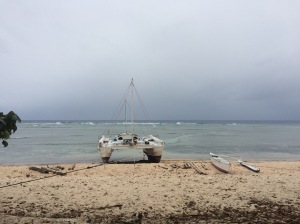
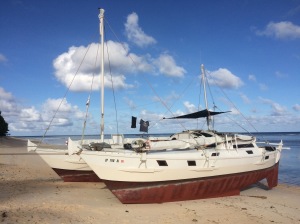
Once the tide had allowed me to pick up my second anchor in the Opua Town Basin, which was set way too close to the beach to be retrieved at anything but high tide without getting stuck in the mud, it was mid-afternoon on the last Saturday of February. Just enough time was left in the day to sail out through the slight curvature of the Veronica Channel and make a small jump out into the Bay. Mangahawea Bay is tucked into the Northwest corner of Moturua Island, the name of which, if my tremendously rudimentary mastery of the Maori language happens to serve me right for once, must mean “Second Island”. This makes sense only if you think of yourself as coming out from the bottom of the bay, as I had just done, and count only the islands on your starboard side. You would pass Roberton Island and then stumble upon my little sheltered home for that night, which offered much needed protection from the winds howling out of the Southeast. Those winds I was about to get to know quite intimately. Another quite fancy-looking cat was already anchored in the little cove and two keelers, as the Kiwis call the boats that have either lost or not yet acquired their second hull, heaved back and forth further out. I maneuvered Aluna around my new neighbors to inspect the area and look for a suitable spot to drop the hook. The inhabitant of the supercat was gesturing wildly towards me without any clearly recognizable vocabulary, which was a bit of a distraction from my delicate task. I did however find a suitable patch with no significant troubles and as soon as the anchor bridle was attached and the motor turned off, the guy now verbally sent his message over to me at the top of his voice. They had a surplus of Snapper fillets cut for the night and wanted to invite me over for diner!

Well fed and well rested during the night I set out in the morning to face the elements, which, as was quite obvious, were not going to stand on my side of the equation. Hugging the wind tightly I was making progress slowly and it wasn’t before one in the afternoon when I finally emerged from the lee of the rugged ridge of Cape Brett. The wind had picked up considerably since the morning hours and I wearily looked up at the spar of Aluna’s big main sail, sensing that soon the threshold for having to take it down would be reached. We were a good bit to the North of the Cape by now, which meant that in order to clear it on the inward tack we had to fight our way about two miles past it to the East. By two o’clock I tacked, confident that I would be able to lay the course for the little and very protected cove of Whangamumu Harbor, just South of the Cape. The winds and seas continued to build and about half an hour into the new tack the virtue of prudency had me take the big sail down. I knew that the consequence of that maneuver were drastic. With the small mainsail up I needed another substantial increase in wind strength to be able to do any kind of efficient windward work. I knew I was going to lose my tack when I saw the outermost tip of the Cape slide slowly across the bows. By that time the bouncy sea had already eroded a good part of my motivation for pressing on. It seemed wise to lower my expectations and make for the entrance of Deep Water Cove, back in the lee on the North side of the Cape.

Just past the Cape on the way down.

Just past the Cape on the way down.

This beautiful cove would become our home for almost a week. Aluna hung on her anchor there protected from the brunt of the fierce winds, which raged on he other side of the mountain ranges around us, with only some violent gusts of turbulence racing down the hillsides towards us from all directions. Finally by Friday a low-pressure system had come traveling down from the tropics and cut into the high-pressure ridge sufficiently to veer our winds over to the Southwest. A bright and sunny morning saw Aluna ghosting in fickle winds past Cape Brett and start her journey South. After the morning hours had withered by with more light wind dancing, once the sun was past its zenith little whitecaps made their appearance, shyly at first, but soon transforming into horses of froth who for once shared the privileges of ridership. Towards five o’clock once again the bending of the spar above the forward mast announced the approaching point of no return. Since Aluna was hugging the wind tightly and barely hanging on to her required course I hesitated, considering too that usually towards the end of the afternoon the diurnal fluctuation of the winds were past their peak. The hope was that I would get away yet again with leaving the big sail up there in spite of my instincts telling me otherwise. That hope, alas, was without any substance whatsoever in the real world and a vicious cracking noise made me aware that I had just flunked today’s exam in practical seamanship. The top forward corner of the once proud mainsail hung sagging sadly from the top of the mast and started to flutter violently in the wind.

A slur of swear words later the tangled mess was wrestled down onto the deck and the trusty mainsail number two was doing the best it could in its place up the mast. But it was not enough. It was more than obvious that with the present winds our course would take us out to the many offshore islands instead of down along the coast. After having just messed up my reputation as an able mariner a more prudent decision was in order and I decided to turn Aluna to starboard. Whangaruru Harbor as I had seen on the chart was just over five miles away to the West. Against the short seas and stiff wind I knew Aluna could make way at about three knots with her trusty little outboard roaring away under full throttle, which meant there was just barely enough time to arrive there before dark. The anchor did drop with the last wink of daylight and it was definitely nice to spend the night comfortably on the bunk instead of bobbing up and down angry seas and listening to hissing winds while contemplating what could go wrong next.

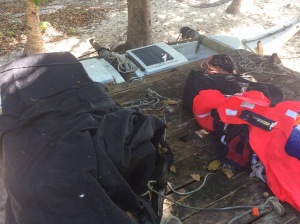
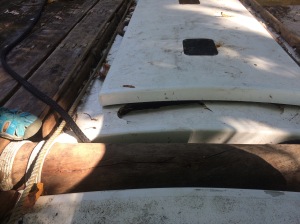
Up early the next morning it was time to put the bamboos from Fiji to work. I knew that time was precious; Southeasterlies loomed again predominantly in the forecast for the upcoming week. So I planned to work like a madman for two days. I hadn’t had a close look at those bamboos since before leaving Savusavu when I had tied them down underneath where the sails are stowed on Aluna’s outboard sides. I had hastily slapped on some paint back then to make sure the picky bio-security officers of New Zealand’s border control would understand that these poles were part of the boat and not some suspicious vegetable materials trying to sneak some nasty alien organisms into the pristine local environment ready to upset the delicate balance f the native flora and fauna. Some of that paint had peeled away and there were some patches of the typical black mold bamboo acquires invariably when exposed to the marine environment. I lifted up the 30’ long culm for the main spar and was surprised how feather light it was. This was great news to me since it meant that the hoisting of the bundled sail would be bit less strenuous from now on. But then I wondered if maybe I was seeing too much of a good thing in front of me. How would those fickle poles hold up to the stresses right there were the halyard attaches, the place I had just seen breaking on my old and tired spars? There was not much I could do for the time being to remedy those worries. Glassing a bamboo spar is a time-consuming and very messy affair and I had neither the time nor the proper workspace available for doing such a task. All I could do was assemble the spar by lashing the doubler culm to the top two thirds of the main one, attach the fittings for the brailing line blocks, fit the loops where the halyard will shackle to, make the flexible connection to the boom at the foot of the sail and then spiral lash the bordered tarp sail in place between the spar and the boom. While this can all be said quickly in one simple sentence, the actual process took a good day and a half.

Sunday at three in the afternoon the new sail flew hoisted up on the mast and looked very, very good. I thought it would be wise to spend a quick hour cleaning Aluna’s underwater hull sides before heading out. That hour would be recouped very quickly on the eighty some mile journey ahead. Then the anchor came up and off we went sailing towards the jagged row of rocks that guard Whangaruru’s harbor entrance. A gentle breeze seemed to come nicely from the North. I saw by the texture of the water surface past the rocks that the winds out there would be a bit stiffer, but nothing like the churned up white froth riding the waves when the mishap happened two days earlier. The stiff spar gave the sail a great shape and for a moment I could feel it’s powerful pull. Unfortunately the magic was not supposed to last very long. Just barely into the rippled water the spar cracked in precisely the same way its predecessor had, without the slightest sign of remorse. Once again a tangled mess of tarp and crooked poles was soon laying in deck and I returned to the harbor for the night.

That was it! The gods, or whoever happens to be in charge nowadays, didn’t want Aluna to go to the big city! The following day a stiff Southwesterly brought Aluna back up to Cape Brett under her small main sail, and another day later she had made it back to Opua, where now she must wait lonely for our return from a road trip South to Auckland. My always helpful friend Peter offered his impressive stand of bamboo for the harvest of two replacement poles for the spars. Those perfectly straight culms are now starting their painfully slow drying process in the shade below his house on the hill, while we are exploring the urban valleys of concrete, scanning them for those rare human activities worth pursuing with integrated passion.

Cape Brett on the way back up.

Cape Brett on the way back up.

Once coming full circle back in the relaxed rural setting of the Bay of Islands we’ll have to engage in some serious engineer’s pondering to find a way to reinforce that critical spot where the amazing power of this ancient apparatus to harvest the winds for locomotion seems to concentrate, pushing the structural integrity of the building material persistently beyond its breaking point.

Since When Do Ducks Have Noses?

February 24, 2013

Once the anchor bites into the mud in Rere Bay it is just shortly after three thirty, which in New Zealand’s mid-summer latitudes means there is still a good five hours of daylight left. Plenty time to try out my new flip-flops, or jandals as they are called in Kiwispeak, and go exploring this magic landscape. I had finally grown tired of the useless rubbish you buy at the Chinese Gold Coin stores, which once again is a Kiwi localization for the notorious Dollar stores of the US. There you buy a pair of flimsy footwork, designed to be so desperately cheap, that after only four days of average bipedal activity the soles under your heel are compressed to a paper-thin substrate and you might as well, as by the way Kiwis love to, walk around barefoot. What goes through those desperate Chinese brains of the guys who design these things? Do they really think that by making them so outrageously bad, they can make us buy a new pair every week? No way, says I, and instead of paying the bargain of five bucks for my new pair of footwear, I shelved out twenty and got a pair of Kiwi designed and produced massage jandals supposedly made from recycled materials.

You have to forgive my rambling about such trivial thing as flip-flops, and consider that this is the only footwear I have been wearing for the last couple years. The two pair of actual shoes are silently collecting mold stored away deep in Aluna’s bilges. In the rare occasion when I do have to extract them from there, like when rolling a good hundred rounds of tree logs uphill with a rusty wheelbarrow a couple weeks ago, my freedom-loving feet sprout blisters like a terminal stage leper. When it comes to hiking, my jandals are just what I need. And even those are sometimes too much, when I want to better feel my path, stand my ground and connect to Mother Earth. Then you can find me Kiwi-style with jandals in hand hopping gingerly over rocky paths. But I’m once again leading you astray, we’re getting literally off the hiking trail.

To my South the bay narrows into a gorge between the colossal stone sculptures up high through which a river comes meandering down. I lower the inflatable canoe, which since it has been expertly repaired by a specialist in Kerikeri became once again the personal transportation vehicle of choice for brining me ashore. I let it slide down the stern ramp into the green and turbid water, the paddle and my new flip-flops are always stowed ready in its rumpled belly. The tranquil river is lined with oyster beds, their sharp, serrated edges exposed at low tide. As many a time in life, the short cut I had carefully plotted on the available maps turns out to be miniature nightmare that sees me drag the canoe through knee-deep mud, squeeze my thin set of bones through towering switch grass and finally stalk up a stretch of thick bush until ending up finally on the proper walking trail. But once on it, it is all easy going, up and over a little promontory from where a good view over Aluna’s anchorage opens up through the twigs and branches of the vegetation.

Camera

Once down in the neighboring bay, where the New Zealand Department of Conservation maintains a little hut for hire along the beach, the path tees out into a wider track bordered by a very informative sign that states in no uncertain terms that the last portion of the path up to the Duck’s Nose is rather steep and requires basic climbing techniques. I look down at my brand new, but already muddy and dusty footwear, and am just being swept away wondering if they are up for the task, when it strikes me as truly odd for a mountaintop to be called Duck’s Nose. Those feathery friends usually have their nostrils built into their beaks and possess no noses worthy of mentioning, much less do they provide sustenance for naming a rugged and rocky peak after such an insignificant body part of theirs. The occupants of the hut on the beach are also strolling along the same path and I ask them if they had already explored themselves the trail to the top of… When I look at the sign once more I quickly realize the blunder. It was no duck, but a bloody duke, who inspired the labeling of the geographical feature I am about to conquer!
After snaking through a humid bush for a little while the track starts ascending and I get the cardio workout I had been longing for. At each turn the turquoise waters of the Bay fall further and further down below and before I know it I find myself standing still at the bottom of an almost vertical rock wall with a menacing piece of chain anchored to it that seems to lead straight up into the heavens.

chain

This is definitely way beyond the traction designed into my flip-flops, as high-tech as their product literature might have sung songs of virtue on the sales rack at the store. Considering furthermore that since I had returned to being a denizen of the watery world, where your inner ear is always in different degrees of upheaval and disarray, I had grown weary of heights to the point of suffering from mild attacks of vertigo when having to look down into voids of space below where my sea legs happened to be anchored. I duck slightly and a little cowardly at this threshold of reaching the Duke’s Nose’s summit, quietly think I might have reached the end of the line for my physicality and start to get myself used to the sad fact that the mighty view from up on the top will have to happen without my humble presence. But my ingrained self-doubt stirs a persistent thirst for adventure. From somewhere deep in the nooks and crannies of a remembered Emmental-like landscape with tender sheets of early and very sublime morning mist, and extracted from one particular stratus of my non-collective subconscious, emerges the rebel with the ultimate cause. Based on his innate knowledge that as a principle you should never give in easily to fear, he drily and rather stoically states that the moment has arrived to leave behind the flip-flops. With the utmost caution, but also very focused on the facts, I slide the little plastic ribbons out of the groove between the big and the index toe, being fully aware that the latter might be a slight misnomer, and deposit the pair of minimalistic footwear ceremonially at the foot of the wall. Gingerly at first I pull myself up on the chain and off the last remaining horizontal hold, looking for safe footholds for my bare feet one at a time. Little by little my determination flowers into confidence and once I get down to it and up the wall, the technique turns out to be a very simple matter. As I heave my body upwards the wall’s inclination becomes less and less, imagine yourself climbing up the temple of Mr. Duke, using the upper rim of his left ear as a foothold, and then slowly making your way up to the apex of his bolding skull.

All of a sudden the chain comes to a sudden end on a flat expanse. A supreme panorama has opened itself up in full circle all the way around me. The peak consists of an almost flat area of about the size of an average tennis court, partially overgrown with brushy tea trees to about waist height. Little paths crisscross this bush and rocky platforms open up at every corner. Previous visitors have etched their names into the dry dirt that has hardened in the shallow indentures of the rocks, but these efforts of public recognition pale and fade into the realm of the petty if not outright ridiculous compared to the splendid disk of planetary surface that stretches out towards the endless horizon line as far as the eye can see. A lofty light-headedness invades my self-esteem while I let my visual cortex bath in the soothing, organic shapes and forms, which each with their own specific texture and coloring reflect the hard brilliance of the late afternoon sun. The sharp contrast between the shadows and lit areas defines very neatly the topographic relief. The thin white lines of froth, where the ocean swells spill their well-travelled momentum onto dark, wet and crumbling rock, delineate like rows of scribbled poetry where one element speaks intimately but insistently with its corresponding other, each generously giving, each eagerly taking, one persistently transforming into the other. You will most certainly have to judge for yourself, but to me it seems that I have arrived at nothing less than the top of the world!

dukespan

Aluna Sails By You

February 18, 2013

It is always a refreshing sight when you see another sailboat actually make use of their sailcloth and when it’s done hard on the wind with the need to tack ahead to arrive at the intended destination then it is just one notch more laudable still. To all those reckless people and their quasi-criminal argument that it’s just too easy to crank up the motor when the going is hard or just slow enough to make your boredom twitch, many of whom I see committing the utmost travesty of powering downwind under bare poles, let me refresh your memories and kindle your isolationist awareness, that while it has been purposely made easy for you to fill your tanks at the pump, and the multiplication of forces from the tiny and lazy effort of turning the key in the ignition switch to the explosive power harnessed as and partially transformed to outrageously violent locomotion is truly astounding, you cannot help but notice that that little motion of the wrist has outrageously far-reaching implications. So if your self-centered attitude and self-serving mentality allows you to consider your miserable self for a short and painless moment as a piece of a whole, and to see your wounded ego for a fraction of your ever so precious time as a responsive and responsible member of our human society at large, you would have to include in your argument of convenience not only the environmental costs of extracting and combusting fossil fuels in such massive quantities, the social and cultural devastation of the globally managed commerce of those fuels, the catastrophic degradation of your own mind, body and spirit through this seemingly comfortable means of transportation, the fact that every time you pay at the pump you literally pour money down into the infinitely deep pockets of a very ruthless few and grant them ample power to influence the key decision making of our already sold out politicians, but also a whole slew of dire consequences you can easily come up on your own if you just allow yourself to have an open minded look around. It should then emerge with blinding clarity that this little motion of your wrist should never be undertaken lightly. If we care at all about the wellbeing of our offspring and future generations of ourselves, then less devastating means of transporting our goods and ourselves across the vast surface of the earth need to be given quite urgent priority!

Should it now come to pass that the already heroic occupants of that other sailboat frantically wave in greeting, seem to be as frantically talking pictures of you with their cameras, sweep by your boat close enough to be within shouting distance, and then communicate through those shouting airwaves their email address and a promise to send the pictures taken to you if you send them a message with your contact information, well, then that truly configures an almost once in a lifetime occurrence.

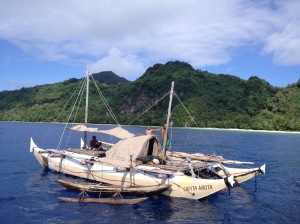
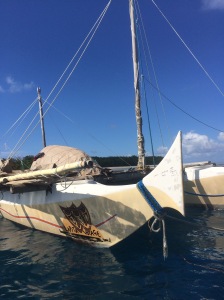
Just such a unique coincidence of fortunate events happened to me under way from Flat Island towards the entrance of Whangaroa Harbor last week. SV Mylady came up on a quite obviously opposite course, hugging the wind tightly and making considerably good progress. Her masters and proud owners turned out to be a Dutch couple and you can read more about their adventures on their blog. For all you people who when sighting Aluna for the first time were wondering about her stubby masts and how her unique rig looks in action, for all those of you who have grown tired of Aluna’s bare-it-all appearance in all those shots of her in splendid looking places, and of course for those of you who are intrigued by the actual workings of her simple but efficient, and very ancient but forward-looking Polynesian rig, here’s SV Mylady’s splendid series of shots of yours truly sailing comfortably on a broad reach through Whangaroa Bay, past Stephenson Island towards the golden portals of a magical sculpture land.

alunabymylady1 alunabymylady2 alunabymylady3 alunabymylady4 alunabymylady5 alunabymylady6 alunabymylady7 alunabymylady8 alunabymylady9 alunabymylady10 alunabymylady11 alunabymylady12 alunabymylady13 alunabymylady14

Away From It All

February 12, 2013

It’s kind of funny, after all this working with schedules to keep, tasks to complete, and simply being at the mercy of other people, going back to sailing on a Saturday morning feels almost a bit like a vacation! On top of it I had finally made it to the famous Friday night jam session up in the hills of Opua, invited by Peter the Potter, whom you might remember from our last year’s visit here in the Bay of Islands. What he very humbly termed as ‘just a bunch of old guys getting together’ turned out to be a happy conglomerate of almost a dozen quite fine musicians, and the jammin’ went on and on into the wee hours of the star struck night. It all meant that I didn’t get to bed until way past two in the morning and high tide, which I needed to get off my shallow anchoring spot, was a half past seven. This fact adds a hint of a weekend family outing with the alpha male slightly groggy from Friday night partying. Luckily there is no family, only my same old self, just slightly grumpier than usual. But who’s there to care?

The winds are on the gentle side and it takes a good three hours to make it out the wide mouth of the Bay of Islands and round the monumental Cape Wiwiki, but that happens just in time before the winds shift. That characteristic shift in the wind I am going to become quite familiar with over the next couple days. Southerlies build up over night and blow themselves out towards noon, then within less than ten minutes turn into moderate Nor easterlies. For already over a week now we’ve been sitting under a stationary high-pressure system, which shows little intentions to move on. The weak maritime winds are eclipsed by land and sea breezes that echo the rhythm of the North Island’s slender but substantial landmass being heated up during the day with warm air rising up into the higher parts of the atmosphere, which in turn draws air in from the cooler waters of the sea. At night then the process inverses, the landmass cools down faster than the sea and the air now rises over the ocean.

My short outing is taking me up the coast a short bit to a place I’ve heard many a sailor talk about with gloomy eyes, singing all kinds of tunes in emphatic tribute to its geographical beauty. The total distance is not much more than thirty miles, but with these feeble winds it turns out to be better to stretch the stint out over two days. Fading daylight finds Aluna anchored in the tranquil Horseshoe Bay on the bigger of the two main Cavalli Islands, Motukawanui. A mile long grey shingle beach stretches out in half moon shape and is littered with bleached shells and driftwood. Long and red beaked oystercatchers sprint effortlessly across the slithery shingles, while my walk is awkward at best trying to gain the Southern end of it, where a necklace of rocks and reefs makes a bridge for steps of a giant out to the smaller island, Motukawaiti. The traction under my feet is worse than over loose sand and it takes two steps to advance the distance of one, which, of course, as a navigator used to advances on liquid has quite a familiar feel to it. The shrill, high-pitched cry of the oystercatcher seems to be mocking my efforts though, and the gulls and terns flying overhead tune in to the frenzied fun. The low-lying sun now breaks through a thickening blanket of dark grey clouds, sending gleaming rays of brilliant brightness down onto the water, giving the whole place an eerie resemblance of midsummer arctic seashores. All that’s missing is a band of bull walruses basking in froth on half submerged rocks.cavalli Camera

The following morning I use my newly gained knowledge of the local weather rhythms and get underway by midmorning to ride the Southerlies until rounding Flat Island where with astonishing punctuality at 11:55AM the days sea breeze kicks in for the home stretch towards the entrance of Whangaroa Harbor. Rounding that pine crested and very aptly named outcrop the dry air allows for a truly far-reaching view. Here’s a run across the horizon for a good 200˚.

whangaroabaypan

Looking at the map you realize that a good chunk Northland’s East Coast lies before you. Cape Brett is just visible through the slot between the two Cavalli Islands and if you zoom in enough to the Northwest the dimples of North Cape jot above the finely drawn horizon line. A brave skipper of a sailboat seems to be making his way up there. Here’s another version of the shot, it’s beauty denigrated by me labeling it with geographical names.

map

whangaroabaypanlabled

Up close North Island’s ragged coastline again turns out to be a veritable sculpture garden. A gallery of prehistoric monsters and a procession of Breughelian characters in various tones of brown march majestically before a tapestry of soothing velvet patches of pastures painted in verdant greens. I’m not sure how the citizens of the land of wine and cheese came to merit the naming of Frenchman’s Rock in their honor, but here it is, crowning a string of islets jotting out from the cozy and very protected little Whangaihe Bay.

Camera

Close to five miles to the West the entrance to Whangaroa harbor is a spectacle all to itself. About two hundred meters separate the North Head’s cliff face from that of the South Head, both head’s apexes also stick their two hundred meters high into the air. Tidal currents of up to two knots are supposed to rip through the gap midway between high and low waters. Luckily for us the wind blows nicely aft and we’re approaching low tide, no dramatic rip currents await us while we squeeze ourselves through.

Camera Camera

Once inside you’re instantly bound by a superior spell of some otherworldly land- and seascape. While straight ahead looms the stuffy boredom of civilization with the little town of Whangaroa and it’s busy marina, to the right lies a wide bay that bottoms out into two fiords carved deep into dark grey sediment rock. Rounded heads stick out of verdant sub-tropical forest like a mighty cast of frozen ancestry overlooking patiently modern man’s frenzy down below. Aluna is drawn into that magic garden, pushed on gently by slightly gusty winds tumbling down from the wooded crests to the North. Little huffs and puffs shove her into the Southern fiord named Rere Bay, where her anchor drops into soft mud only a foot or two under her keels. This place begs to be explored!

Camera


Temples of Green (and Brown)

February 5, 2013

Some people go to church to hold onto their bits of sanity. I go for a walk in the bush. In fact the lofty naves of Christian churches, especially their gothic variety, the majestic European cathedrals, seem to me nothing but stylized forests with a suspended canopy held up by pillars. But the stroll through a forest is unconfined by heavy books on altars and no donation box decorates the exit. The different climes of our planet’s many regions make for a variety of thickets, some dense, some stoically scarce, some lush and impenetrable, some like manicured by imperial gardeners. The subtropical bush of New Zealand’s Northland is timid and well behaved. No poison critters lurk under foot and not screaming monkeys fly overhead. The ever varying cries of the Tui up in the crown of a giant Kauri tree, the teasing dance of the fantail always just out of arm’s reach, the sweet scent of the Manuka trees, the unique geometry of the fern trees, all make for a quivering feast for the senses. The mind goes quiet for a while.

alunaopua1

I started out just before noon from Aluna’s anchorage in “downtown” Opua, took the car ferry across the ever-busy Veronica channel. From the Okiato side it’s a short walk along the asphalt road up hill, then a small sign leads me off onto a side street. The well of the first European capital of New Zealand is fenced off and a sign tells a flimsy history of land deals between the Brits and the Maori. Land purchased from the chiefs? What currency was used to pay up? Muskets? Gunpowder? Then an elevated walkway leads straight across the marsh, over a meadow and then descends into the bush. The delicate balance of green and brown, sprouting and rotting, light and darkness, erases the aftertaste of the shady world of economics I’ve been exposed to recently. No abstract values interfere.

bush1 bush2 bush3 bush4 bush5 bush6 bush7 bush8 bush9 bush10 bush11 bush12 bush13 bush14

My Swiss genes stir and I don’t resist the urge to climb a mountain. Nothing even remotely close to the colossal rocks of the Alps anywhere in sight, but Mount Tikitikioure will have to do. It serves as a platform for cell phone and all kinds of other antennas and a service road leads up to the summit. That summit stands at not even 200 Meters elevation, but it still provides a mighty good view out onto the waters of the Bay of Islands.

mttikitikiourepan

Back home at night the soothing of strained muscles and worn soles makes for good sleeping. With the dire forecast of well-paid climatologists we better enjoy our vegetating gardens while they’re still around! Bare and bone-dry deserts windswept with grey exhaust gases and clouds of black soot await us while our neglected offspring fight to the knuckle for little droplets of water.


Follow

Get every new post delivered to your Inbox.

Join 44 other followers